
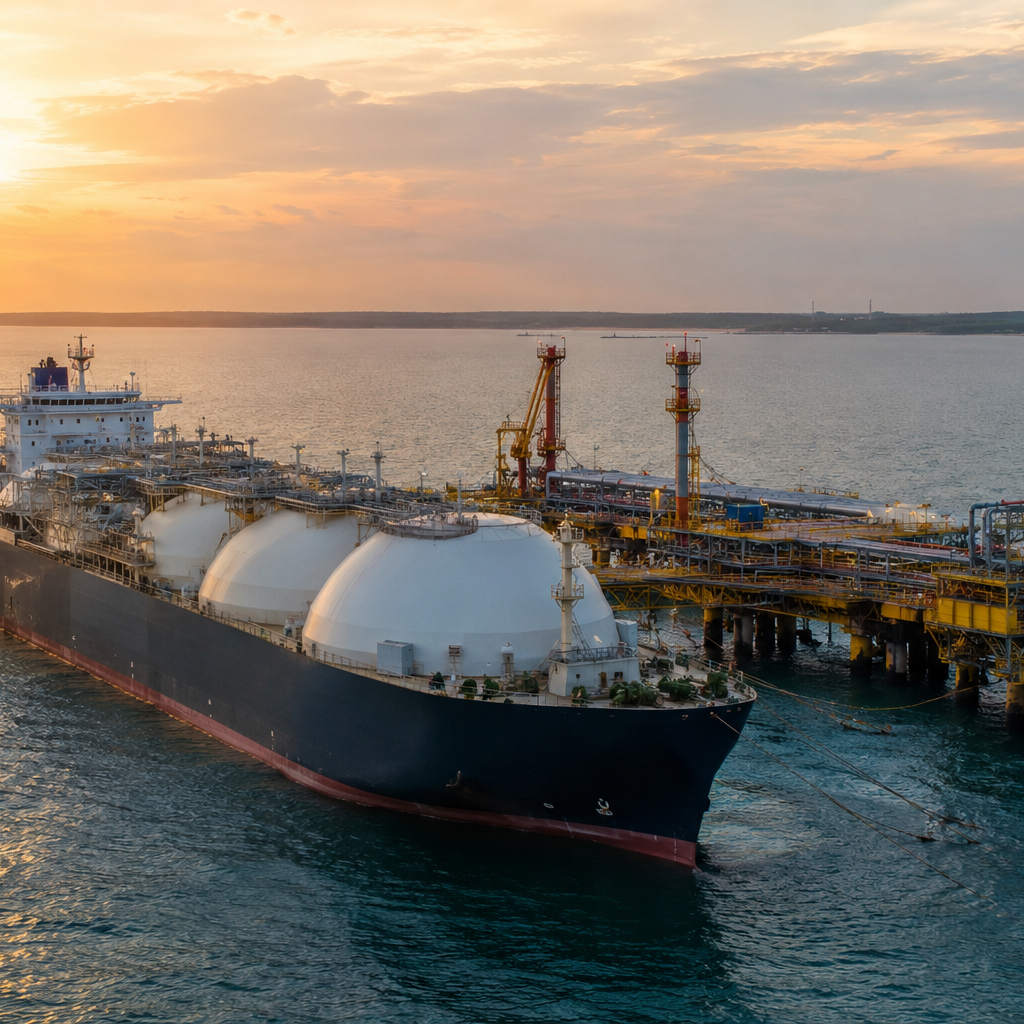
Since taking office in January 2026, Gabon’s Petroleum and Gas Minister, Clotaire Kondja has pushed to attract international capital and monetize Gabon’s natural gas resources. A new Gas Code is under development, alongside plans for a 130–150 km pipeline linking Gamba to Libreville by early 2028. Perenco’s USD 2 billion Cap Lopez LNG project is designed to produce 700,000 tonnes of LNG a year while significantly reducing flaring.
Gabon already has plenty of gas. The real challenge is turning it into affordable power for homes, businesses, and the national grid.
1. Why Gas Matters to Gabon Now
Oil still carries the economy, but the trend is difficult to ignore. Crude output is expected to contract by about 3% in 2026. Oil accounts for around a quarter of GDP and about 60% of export earnings. At the mature Etame Marin field, more than 88% of reserves have already been produced.
Gas offers a second pillar. It can supply power, feed industrial processing, and reduce the waste of associated gas that is flared. For a country facing electricity shortages, that makes gas an energy-security question as much as an export question.
2. Where the Gas Opportunity Sits
Officials cite an estimated 28 trillion cubic feet of gas reserves, described in one forum report as tested onshore reserves. A resource figure of that size is not the same as gas delivered to a buyer. The gap between the two is infrastructure.
Cap Lopez is the flagship. It is intended to monetise offshore gas while reducing flaring, and to yield LPG alongside LNG. Its timing, however, needs care:
- Officials have pointed to a 2026 start-up.
- Dixstone’s CEO has spoken of operations by the end of 2027.
- As of late August 2026, an LNG carrier was still being converted into a floating storage unit in Dubai.
For investors, the commercial start date remains a moving target rather than a settled guarantee.
Cap Lopez is the largest project, but not the only one. Perenco has also agreed to build a smaller gas-fired plant in Mayumba with Gabon Power Company, using offshore associated gas to supply the country’s remote south. A second LNG facility, planned for Port-Gentil at a cost of roughly $983 million, would add further capacity. Together, they show more than one developer betting on Gabon’s gas.
3. Who Would Actually Use Gabon’s Gas
Who Actually Burns the Gas:
- The national utility SEEG and its gas-fired plants.
Aksa Energy holds a 10-year contract to rent and operate 145 MW of gas plants in Libreville and Port-Gentil, with a commissioning date listed as June 2026. - Emergency generation, now running on gas.
Karpowership’s floating power plant supplies 150 MW to Libreville. It originally ran on imported fuel oil, but switched to Gabon’s own natural gas in 2025, cutting emissions and fuel costs. - Industry.
Cap Lopez output is expected to support local manganese processing. The Gamba–Libreville pipeline is framed as part of a push to process primary resources domestically by 2029. - Households and small commercial users.
LPG from Cap Lopez targets the cooking-fuel market, where clean-fuel demand is easiest to explain.
4. Real Problems, Real Opportunities for Private Capital
The gas is not the scarce resource instead, the scarce resources are pipelines, power plants, a creditworthy buyer and a price that works for both sides.
The power side shows the strain. In 2023, installed capacity was 704 MW against demand of 1,039 MW, and SEEG was placed under temporary administration from August 2024 to May 2025. In March 2026 the president pressed SEEG for solutions as outages spread across Greater Libreville, citing rising demand and ageing infrastructure. Even where generation exists, a former energy minister has said outages are increasingly due to the transmission network.
The pipeline from Gamba to Libreville is therefore central. Without it, gas produced in one region cannot reliably reach the capital’s power plants.
Gabon is not short on gas, ambition, or reasons for investors to pay attention. What it still needs is the connective tissue pipelines, power plants, and reliable payment that turns molecules into megawatts.
