November 2, 2026 · by Carl Mbeng · 6 min read
Central Africa’s oil and gas investment opportunities depend on the ability to turn announced targets into funded, deliverable projects. Production ambitions and new licensing rounds attract attention, but investors also need evidence of commercial agreements, infrastructure access, regulatory approvals and credible execution schedules.
The strongest opportunities identified in the region include developments connected to existing infrastructure, gas monetisation and midstream facilities. Their investment case depends on clear routes to production, reliable buyers and financing tied to measurable project milestones.
1. Existing Infrastructure Can Strengthen the Investment Case
The Republic of Congo’s ambition to increase oil production to 500,000 barrels per day has been associated with different target years, including 2027, 2029 and 2030. These changing timelines reinforce the importance of assessing individual projects and their delivery schedules rather than relying on a national production target.
Developments connected to existing facilities can offer shorter routes to production. TotalEnergies announced the Moho G discovery in April 2026, with development planned through a tie-back to the existing Moho infrastructure. Access to established production facilities can reduce the infrastructure required for a new development.
Perenco’s Kombi 2 platform provides another example of investment in existing assets. Installed on the Kombi-Likalala-Libondo II field in early 2026, the platform forms part of a redevelopment programme involving more than US$200 million, including drilling phases.
In Gabon, Gabon Oil Company’s mature-field portfolio makes the state-owned company an important commercial counterpart for potential joint ventures. Investors should assess its financial capacity, governance and contractual commitments while distinguishing its shareholder role from the responsibilities of the government and sector regulators.
2. Gas Monetisation Depends on Buyers and Delivery Infrastructure
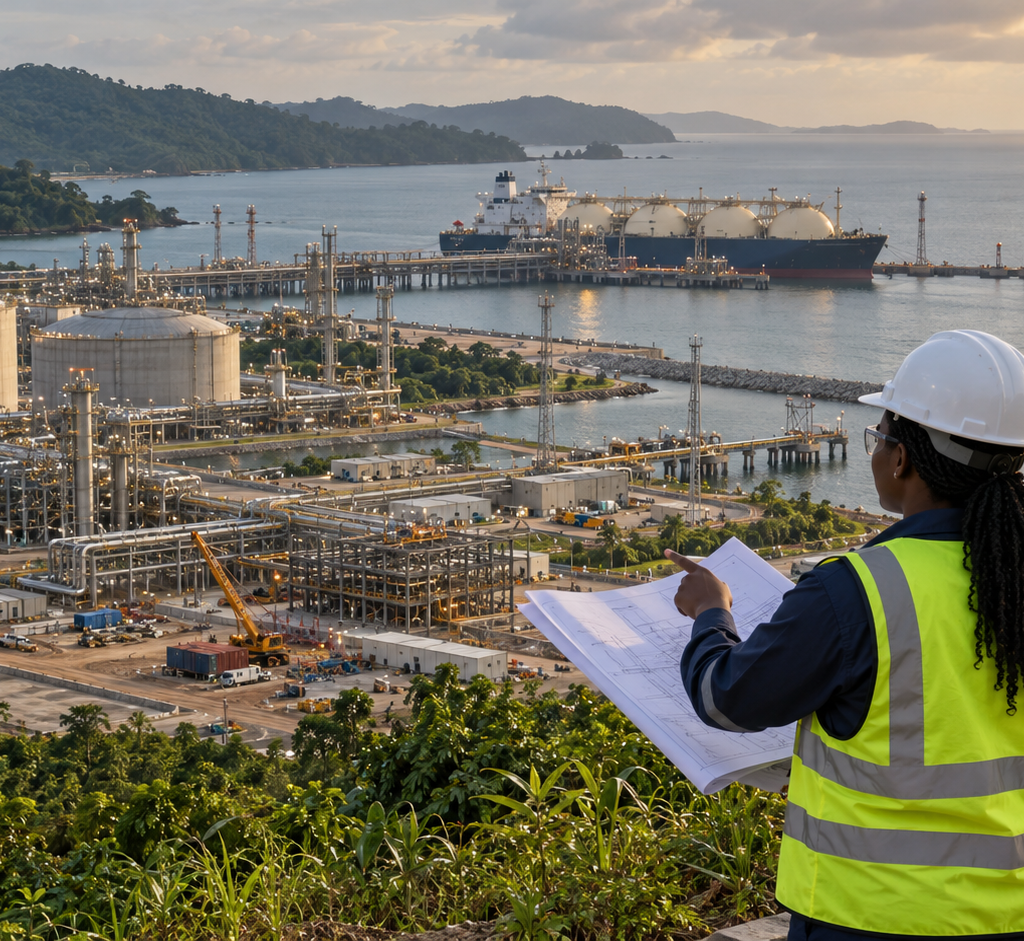
Natural gas is becoming increasingly important to Central Africa’s energy investment landscape. Gas processing and export projects can diversify revenue sources, although their bankability still depends on supply availability, infrastructure performance and commercial terms.
The Republic of Congo has expanded its LNG infrastructure. Eni announced the start-up of Congo LNG Phase 2 in December 2025, including the Nguya floating liquefied natural gas facility. The expansion brought the project’s total liquefaction capacity to 3 million tonnes per year.
In Equatorial Guinea, declining crude production has increased the importance of the Gas Mega Hub strategy. Punta Europa’s processing and export infrastructure and the Aseng gas development are central to this approach. The Aseng project reached final investment decision on 31 March 2026.
Gabon’s Cap Lopez LNG project illustrates why investors must distinguish earlier targets from updated delivery expectations. The project has a planned LNG capacity of 0.7 million tonnes per year. Although earlier announcements targeted production from 2026, the International Energy Agency’s tracker, dated 1 October 2026, lists expected first LNG in 2027.
For investors, long-term sales agreements, credible buyers and sustainable pricing arrangements are important foundations for committing capital. Short-term market prices alone provide an incomplete basis for evaluating a long-lived gas project.
3. Exploration Announcements Require Licensing Due Diligence
New licensing rounds create opportunities, but an announced block offering does not establish that a project is ready for investment.
The regional briefing identifies Equatorial Guinea’s EGRonda 2026 offering of 24 blocks and the Democratic Republic of Congo’s announcement of 52 exploration blocks in May 2025. It also highlights Equatorial Guinea’s 2024–2025 tax reforms, including reductions in corporate and dividend tax rates.
Before committing funds, investors need to examine the applicable licensing documents and fiscal treatment, confirm block boundaries and assess environmental approval requirements. These checks are particularly important where licensing schedules or award procedures remain uncertain.
In the Democratic Republic of Congo, the cancellation of the earlier licensing round and concerns about overlap between exploration areas, peatlands and conservation initiatives highlight the importance of environmental and legal due diligence.
4. Sovereign and Contractual Risks Can Change Project Economics
Government intervention, disputed ownership rights, licensing delays and contractual uncertainty can affect both project delivery and access to financing.
The disputes involving Savannah Energy, Chad and interests in the Chad–Cameroon pipeline illustrate these risks. In the COTCo-related proceedings, Savannah Midstream Investment Limited has sought approximately US$330 million in principal, plus more than US$67 million in estimated interest and costs.
This is an arbitration claim, rather than an established liability or an amount attributable solely to Chad. The proceedings involve five respondents, including Chad, two SHT entities, Cameroon’s national hydrocarbons company SNH and COTCo. The amounts were disclosed before the September 2026 reporting and should not be described as a new increase in exposure during that week.
For projects involving state partners, the briefing recommends examining offshore escrow arrangements, political risk insurance and international arbitration provisions. Their effectiveness depends on the specific transaction, the applicable law and the enforceability of the agreed protections.
5. Cameroon’s Refineries Show Why Financing Milestones Matter
Cameroon’s refinery projects demonstrate the need to distinguish financing mandates, signed funding agreements and completed infrastructure.
CSTAR’s Kribi refinery is designed to reach 30,000 barrels per day. The project involves SNH, Tradex and private partners. In November 2025, BGFIBank Cameroon received a mandate to arrange financing. A subsequent agreement signed on 5 May 2026 secured CFA 120 billion, reported at approximately US$206 million, to support SNH’s participation.
That agreement represents a financing milestone rather than confirmation that the entire project is funded. The phased development envisages initial capacity of approximately 10,000 barrels per day, followed by expansion to 30,000 barrels per day. Announced commissioning dates remain dependent on construction progress and the remaining financing.
Meanwhile, SONARA’s refinery in Limbe has remained idle since the 2019 fire. Its rehabilitation programme has been reported at approximately US$533 million, with a restart target of December 2027.
The projects present different execution and financing profiles. Investment assessments should examine remaining funding requirements, independently verified construction progress, commissioning conditions and the associated storage and logistics infrastructure.
6. Four Priorities for Assessing Investable Projects
- Assess access to existing infrastructure. Examine how tie-backs and mature-field redevelopment can affect capital requirements and the time needed to reach production.
- Secure credible gas buyers. Evaluate the buyer’s financial strength, contract duration and pricing arrangements alongside the project’s supply and export capacity.
- Link infrastructure funding to verified progress. Structure disbursements around independently confirmed construction milestones.
- Address government-related risks. Examine state-partner obligations, contractual protections, political risk insurance and dispute-resolution arrangements.
Projects such as Moho G, Kombi 2, Congo LNG, Aseng and Cap Lopez illustrate different stages of development. Investors need to distinguish a discovery, an investment decision, construction progress and operating production when assessing their readiness for capital.
Central Africa’s oil and gas opportunities become investable when production ambitions are supported by credible buyers, deliverable infrastructure and enforceable commitments. The central investment question is how each project will convert its resource base into reliable cash flow, and what evidence supports the next release of capital.
Sources and Further Reading
- TotalEnergies, Moho licence discovery announcement, 13 April 2026.
- Perenco, Kombi 2 development announcement, 12 June 2025.
- Eni, Start-up of Congo LNG Phase 2, 2 December 2025.
- African Energy Chamber, Aseng final investment decision, 1 April 2026.
- International Energy Agency, Global LNG Capacity Tracker, status as of 1 October 2026.
- Business in Cameroon, Savannah’s COTCo arbitration claims, 28 September 2026.
- SNH, BGFIBank financing mandate for CSTAR.
- Business in Cameroon, CSTAR financing agreement, 6 May 2026.
BASIS: Transition Finance Watch
Get the next issue
One deal insight, one regulatory watch item, one honest opinion — every month.