
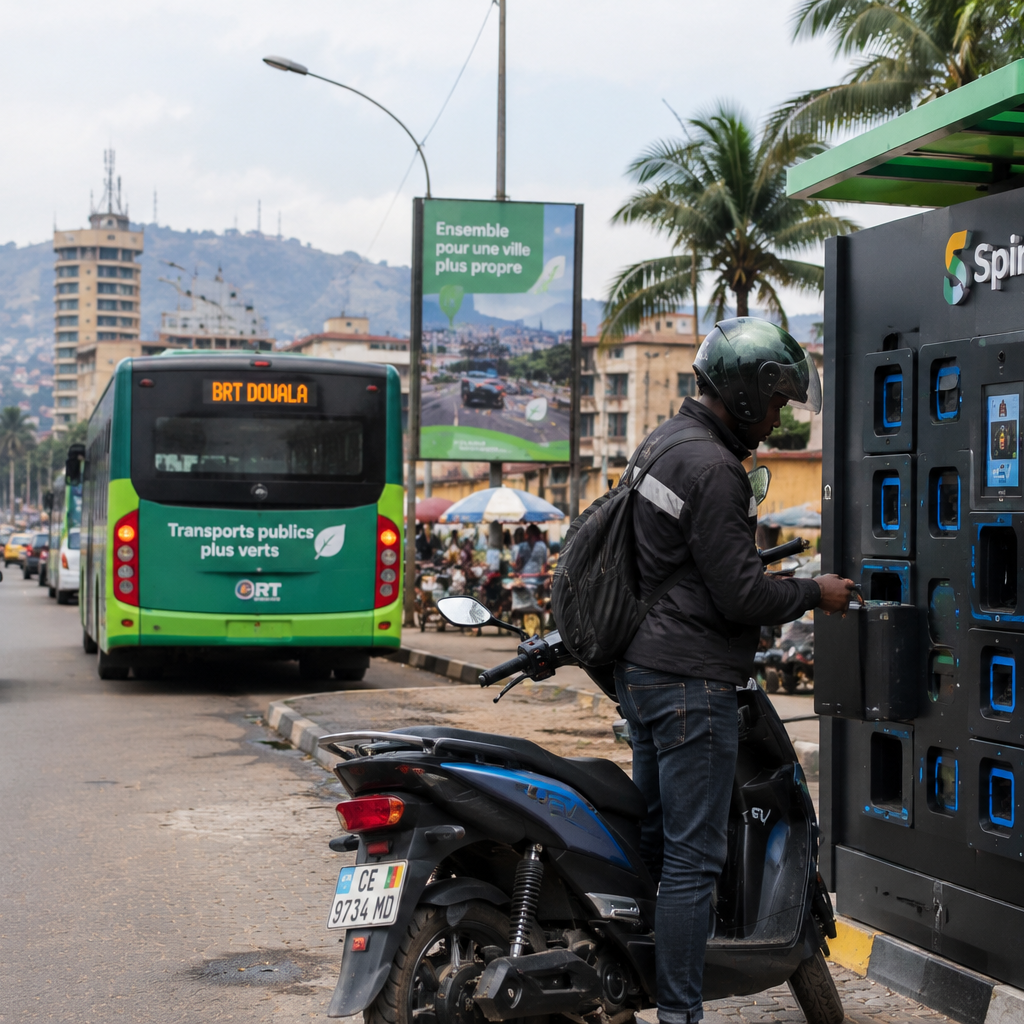
Cameroon’s electric-mobility market is developing rapidly, supported by tax incentives, growing private-sector activity and emerging electric public-transport projects. The country’s main incentive, a 50% reduction in the taxable value of imported electric vehicles, batteries and charging stations, together with an excise tax exemption, has been in force since 1 January 2025 for 24 months. Unless the government extends it, the incentive is due to end around the end of 2026.
For investors considering entry into Cameroon’s e-mobility market, the opportunity is growing, but so are the infrastructure and financing challenges. The market is already developing faster than the policy framework was designed to support.
1. Spiro’s Rapid Expansion Tests Infrastructure Capacity
Spiro’s growth illustrates how quickly Cameroon’s electric-mobility market is developing. The Indian two-wheeler operator entered Cameroon in May 2025 with a 100-motorbike pilot in Douala, supported by a CFA 29.1 billion Afreximbank facility.
By April 2026, Spiro had installed more than 15 battery-swap stations in Douala and partnered with Royal Holding, a Yango operator, to deploy its first commercial electric-motorbike fleet. It expanded to Yaoundé in June, targeted Bafoussam for the fourth quarter, and signed an order for 1,000 motorbikes with distributor Motozone, worth roughly CFA 540 million.
A $215 million capital raise closed on 1 June 2026. Part of the funding was allocated to local battery infrastructure and assembly capacity, with national coverage targeted by 2028.
In less than eighteen months, Spiro moved from a pilot in one city to the country’s largest e-mobility operator by visible presence. Its battery-swap network, however, continues to expand alongside its growing fleet rather than ahead of it.
2. Public Transport Electrification in Douala and Yaoundé
Electric bus development is progressing at different speeds in Cameroon’s two largest cities. Douala’s bus rapid transit (BRT) system, valued at CFA 335.3 billion (approximately $543 million), has 78% World Bank financing, alongside a further $100 million component for a privately operated bus fleet. It is the more advanced project in terms of funding.
However, by mid-2026, the project faced a CFA 104.6 billion funding shortfall, equivalent to 40% of its budget. The World Bank rated it “moderately unsatisfactory” in March, and a project review was underway at the time of the source report.
Yaoundé’s TransYaoundé project, by contrast, was relaunched on 23 September 2026 after a decade of delays. Its plan includes 52 electric buses, marking the first clear commitment to electric buses in either city’s public-transport system.
Financing, potentially through an AFD loan of €100 – 180 million, has not yet been finalised.
3. Why the Shift to Electric Mobility Matters
The economics increasingly favour electrification. Road-fuel imports accounted for an estimated 3.6% of GDP in 2025. Meanwhile, energy costs for petrol and diesel vehicles are 6.4 times higher than those for electric vehicles in Cameroon, a wider gap than in Tunisia, South Africa or Kenya.
The difference widened further in 2026. In September, the regulated diesel price stood at CFA 828 per litre, compared with an import cost of CFA 860.10. This left the state covering a subsidy of CFA 315.47 per litre, up from CFA 109.22 in July.
Douala alone has an estimated 800,000 motorcycle taxis, while only a few hundred are currently electric. The potential market therefore remains considerably larger than the number of vehicles already converted.
4. Barriers and Risks Facing the Market
Infrastructure is struggling to keep pace with fleet expansion. Charging and battery-swap facilities remain limited relative to planned vehicle deployments. Most of the named operators report single-digit station numbers: PROXYM has three and upOwa has three. Spiro’s more than 15 stations in Douala by April 2026 are an exception, but even this network needs to expand several-fold to support Motozone’s 1,000-motorbike order and nationwide growth.
Public-transport financing remains uncertain. Douala’s $543 million BRT project has an unresolved funding gap of 40% and a “moderately unsatisfactory” World Bank rating. Yaoundé’s plan for 52 electric buses still lacks firm financing.
The tax-incentive window is limited. The 24-month incentive may not be extended. Investors relying on the current tax treatment should prepare for the possibility that it expires as scheduled.
Official adoption figures may lag behind market developments. The source profile’s figure of “more than 100 electric motorbikes in 2025” is likely outdated given Spiro’s expansion in 2026. Investors should treat headline adoption figures as indicative rather than current.
5. Investment Opportunities in Cameroon’s E-Mobility Market
- Make use of the incentive while it remains available. The 50% reduction in the taxable base and excise tax exemption provide vehicle, battery and charging-station importers with a limited window to benefit under the current terms.
- Expand charging and battery-swap capacity ahead of fleet growth. Spiro’s expansion indicates that infrastructure, rather than demand, is the main constraint. Operators and financiers investing in capacity now could avoid competition for a limited number of stations later.
- Follow the Douala BRT review. The outcome, expected in the source report’s quarter, will determine whether the $100 million private bus-fleet component proceeds at its original scale.
- Monitor TransYaoundé’s financing. A confirmed AFD loan would make it the country’s first financed electric-bus project and could provide a model for similar projects in the region.
6. What Investors Should Watch Next
Cameroon’s e-mobility incentives were introduced for two years, and the second year is nearly over. Investors considering entry into the market should assess the opportunity before the current incentive period ends, while accounting for infrastructure capacity, public-transport financing and the reliability of available adoption data.
Cameroon’s electric-mobility opportunity extends beyond importing vehicles. Charging and battery-swap infrastructure, fleet expansion and electric public transport are all part of the market’s development. Investors should assess these opportunities alongside the limited duration of the current tax incentives and the financing still required for major transport projects.
Sources and Further Reading
- K&Y Energy Advisors, “Cameroon Electric Mobility Profile” (January 2026).
- Ecofin Agency, Business in Cameroon, Investir au Cameroun, Semafor and Electrive.com, on Spiro’s expansion in Cameroon during 2025–2026.
- Business in Cameroon, Investir au Cameroun and AllAfrica.com, on the Douala and Yaoundé BRT projects during 2025–2026.
- Business in Cameroon, on Cameroon’s fuel-subsidy figures for September 2026.
